Science for practice
Assessing the Prospects of Weightlifters
English summary of Tyazhelaya Atletika. Ezhegodnik 1984 (Moscow: Fizkultura i Sport, 1984), pp. 49–53: the text is paraphrased, not translated; figures are the original images.
Results rise every year, so selecting the most talented lifters matters more and more. A lifter's future can be judged from the progress of his total; annual gains, that is rapid, continuous development of speed-strength qualities, are considered the most informative indicator. Many studies followed results against training age, but people now start weightlifting at very different ages, so practice needs to know how results develop depending on the starting age. That is the subject of this article.
Material
We analysed the progress of 131 highly qualified lifters from ten body-weight categories who competed in 1979–1982: 42 in the light categories (52–67.5 kg), 35 in the middle (75–82.5 kg) and 54 in the heavy (90 kg and over). Five (3.8%) began at 11–12, 36 (27.5%) at 13–14, 51 (38.9%) at 15–16, 24 (18.3%) at 17–18 and 15 (11.5%) at 19–21. The analysis covered the whole group, the 31 who later became world record holders (11 light, 8 middle, 12 heavy; one began at 11, nine at 13–14, ten at 15–16, eight at 17–18 and three at 19–20), the other 100, and the weight groups separately. Totals were converted to conditional units (c.u.) by M. V. Starodubtsev's scoring table (1981) and processed by computer.
Results
The mean starting age was 15.6±2 years for all 131, and the same for the record holders and the other 100, but it differed by group: 17±2.2 in the light categories, 15±2.1 in the middle and 15±1.7 in the heavy. The result after the first year, which we call the initial result, averaged 183 c.u. for record holders and 175 c.u. for the rest (no significant difference), roughly a class III total.
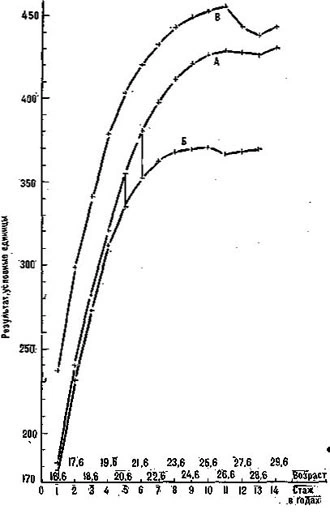
Fig. 1 shows that record holders (curve A) and the other 100 (curve B) progressed identically, with equal gains, for the first four years. From the fifth year the record holders gained more, and by the end of years 5, 6, 7, 8, 9 and 10 they were ahead by 20, 27, 36, 44, 51 and 56 c.u. In kilograms the gap at the end of year 10 is 27.5 kg in the 56 kg class, 37.5 kg at 82.5 kg and 42.5 kg at 110 kg. Results of record holders rose for 11 years on average, those of the rest for 10. Since most lifters (about 39%) started at about 15.6, record holders reached their peak at about 27.
The maximum-growth curve (C in Fig. 1) looks different. Gains are especially large in the first two years: 237 c.u. after year one, roughly class II, plus 62 c.u. in year two. Years 3 and 4 give equal gains, and from year 5 gains are slightly below the record-holder average. Such lifters thus show their capacity for maximum growth in the first two years, reaching 299 c.u. by the end of year 2: totals of 207.5 kg at 56 kg, 290 kg at 82.5 kg and 320 kg at 110 kg, which meets the Candidate Master of Sport norms of the 1981–1984 classification. Such athletes reach record results much earlier.
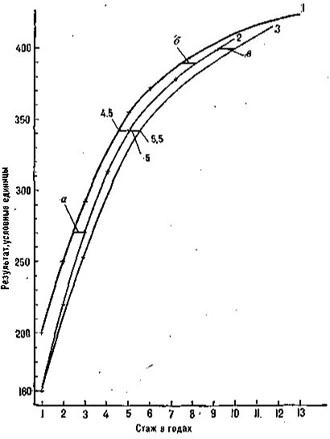
Fig. 2 shows the weight groups, with a mean starting age of 15. Light lifters have a much higher initial result after year one (about 200 c.u. against 160 for the middle and heavy) and stay slightly above the middle group each year, though the difference shrinks, to just 4 c.u. (2.5 kg) in years 8 and 9. Heavy lifters, equal at the start, gradually fall behind the middle group, by about 8 c.u. (5 kg) at the end of years 7, 8 and 9. Light lifters therefore reach a given result earlier than middle-weights and heavy lifters later: 343 c.u. is reached by the middle group at the end of year 5, by light lifters at 4.5 years and by heavy lifters at 5.5. From year 3 to 8 light lifters are about half a year ahead of the middle group, later 4 months. Heavy lifters lag increasingly after year 5, from 6 months to a year by year 10; the 400 c.u. that middle-weights reach at the end of year 9 comes to heavy lifters at the end of year 10. These data confirm and supplement V. S. Kopysov and P. A. Poletayev (1979).
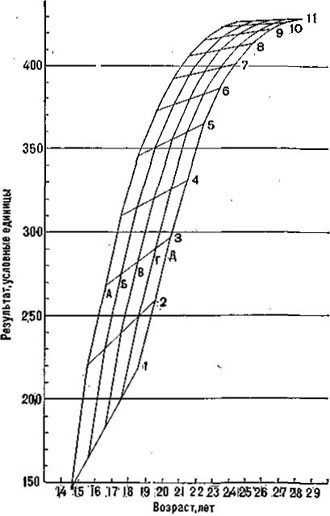
The younger the starting age, the lower the result in the first years, and the older, the higher (Fig. 3). After year one those who began at 13.6 are on average 72 c.u. behind those who began at 17.6; after year five, 18 c.u. Achievements level out after eight years (in year 9), with a difference of only 6 c.u., or 2.5 kg at 56 kg to 5 kg at 110 kg.
Younger lifters gain much more in early years, whereas at ages 20–22 gains are lower the earlier the start. For those who began at 13.6 the gains are 73 c.u. by the end of year 2, 47 by year 3 and 42 by year 4; for those who began at 17.6, 41, 37 and 34. In years 5, 6 and 7 the difference is only 4 c.u., and from year 8 gains are practically equal.
Practical use
Fig. 3 can be used to judge future achievement and prospects. A lifter whose growth lags well behind these averages cannot be expected to become a record holder. If he keeps up, only after four years can it be told whether he can reach the top, by whether he attains the optimal record-holder results at the end of years 5 and 6, taking the weight group into account.
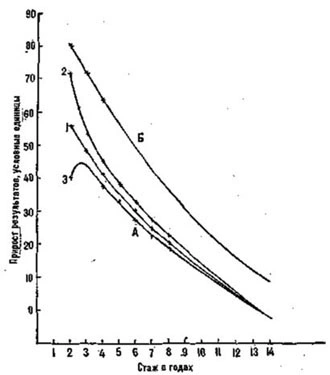
Planning needs the possible gains by training year (Fig. 4). An individual's gains do not follow the figure year after year: they may match it for two or three years, then fall below, and in some years greatly exceed it, up to the maximum (curve B). On average growth ends in year 11, with a gain of 17 c.u. over years 8–11, but a lifter can gain 20 c.u. in year 9, 12.5 in year 10 and 7.5 in year 11. A lifter who lacked the optimal gain in the two previous years (393 c.u. against the average 411 at the end of year 8) can add 35 c.u. rather than 17 and reach 428 c.u. by year 11.
High results were reached both by those who began at 13–15 and by those who began at 18–20. Rapid growth lasted eight years, then slowed and stopped on average after eleven. Some light lifters who began at 18–20, and some at 100 kg and over, improved for 12–14 years. The material thus allows future totals to be foreseen by category and starting age, and prospects assessed.
Height
Height matters, and it has changed since the press was dropped from competition. Mean heights of our 131 lifters: 52 kg, 153.8 cm; 56 kg, 155.7; 60 kg, 157.7; 67.5 kg, 161.3; 75 kg, 164.9; 82.5 kg, 168.6; 90 kg, 172; 100 kg, 177; 110 kg, 181.9; 120 kg, 186.8; 130 kg, 191.6 (correlation of weight and height 0.891). Height has grown in every category except 90 kg, less in the 67.5–82.5 kg categories and more in the extreme ones, 52–60 kg and 100 kg and over.