Training methods and planning
Features of Training Methods for Weightlifters of Different Ages
English summary of Tyazhelaya Atletika. Ezhegodnik 1984 (Moscow: Fizkultura i Sport, 1984), pp. 36–42: the text is paraphrased, not translated; data tables are given in full with English labels; figures are the original images.
Under the 1977 Regulations on Children's and Youth Sports Schools, specialisation in weightlifting may begin at 13. Coaches therefore need to know how known means and methods of speed-strength training apply at different ages. Yet young lifters' training is often considered without regard to age, or across the whole 13–18 range, although adolescents (15–16) and youths (17–18) differ considerably in biology; stage tasks need means and methods suited to age and qualification.
Design of the experiment
The study aimed to examine by age how different loads affect growth of results in special physical preparation, and how lifters adapt to prolonged identical loads in the control exercises. Three age groups of 30 lifters each took part, each split into three subgroups of 10 working with different experimental loads (Table 1).
Table 1. Initial data
| Age group, years | Classification | Training experience, years | Subgroup | Body weight, kg (M ± m) | Initial mean results, kg | |
| Snatch | Back squat | |||||
| 13–14* | Unclassified** / Class III juniors | 0.5–1 | I | 67.8±4 | 47.5 | 85.3 |
| II | 52±1.5 | 31.3 | 63.4 | |||
| III | 60±1.8 | 34.3 | 63.7 | |||
| 15–16 | Class III–II | 1.5–3 | I | 69±3.0 | 67.5 | 120.0 |
| II | 70±5.5 | 70.3 | 132.0 | |||
| III | 71±3.8 | 70.8 | 125.0 | |||
| 17–20 | Class I – Master of Sport | 4–6 | I | 72.5±4.5 | 87.5 | 165.0 |
| II | 73.8±5.2 | 95.2 | 175.0 | |||
| III | 72.3±3.4 | 92.5 | 182.5 | |||
* The 13–14 experiment is described in L. S. Dvorkin, The Young Weightlifter (Moscow, FiS, 1982, pp. 97–105). ** After 2–4 months every lifter in this group had reached a classification.
Three loads were compared in each age group. The small load used 50% of maximum for 13–14-year-olds, 60% for 15–16 and 65% for 17–20, with 6 barbell lifts (BL) per set and 36 per exercise per session. The medium load used 70%, 80% and 80%, with 3–4 BL per set and 18 per exercise. The large load used 80%, 90% and 90%, with 1–2 BL per set and 12 per exercise. The control exercises were the classic snatch and back squat; apart from them, all subgroups of an age group had identical exercises and volume (Tables 2 and 3).
Table 2. Average load (BL) per training session
| Session in weekly cycle | Age, years | ||||||||
| 13–14 | 15–16 | 17–20 | |||||||
| I | II | III | I | II | III | I | II | III | |
| 1st | 114 | 96 | 90* | 121 | 105 | 99 | 140 | 124 | 118 |
| 2nd | 72 | 64 | 48 | 124 | 108 | 102 | 100 | 84 | 78 |
| 3rd | 86 | 66 | 60 | 73 | 57 | 51 | 54 | 54 | 54 |
| 4th | 99 | 81 | 75 | 97 | 81 | 75 | 142 | 126 | 120 |
| 5th | — | — | — | — | — | — | 54 | 48 | 42 |
* Within a session BL varied between subgroups with the load in the experimental exercises.
Table 3. Average weekly and monthly training load (BL) by age and subgroup
| Age, years | Training cycle | |||||
| Weekly | Monthly | |||||
| I | II | III | I | II | III | |
| 13–14 | 371 | 307 | 273 | 1200 | 960 | 800 |
| 15–16 | 415 | 351 | 327 | 1450 | 1195 | 1096 |
| 17–20 | 490 | 436 | 412 | 1758 | 1547 | 1463 |
The experiment lasted 10 months for the 13–14 group and 6 for the others, with tests at the start and every 2 months. Pulse was recorded before, during and after the control lift in the 13–14 group, but only at the 10th second of recovery in the others.
Snatch
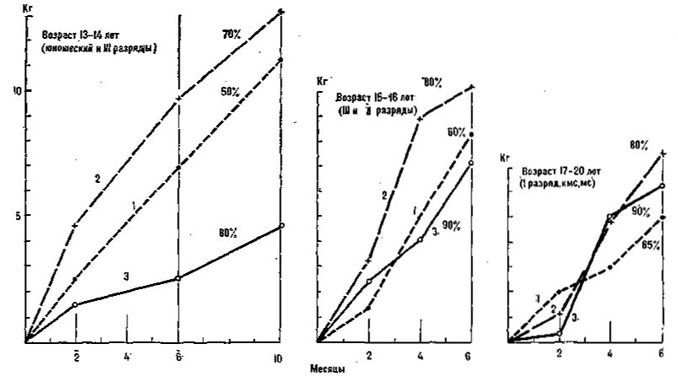
At 13–14 results rose in all subgroups at 2, 4, 6 and 10 months, significantly in I and II throughout but in III only at 10 months (Fig. 1). At 15–16 six months gave significant gains in the first two subgroups (t = 2.8; 3.3; 2.1). At 17–20 gains were 5 kg in I (t = 1.1), 7.5 in II (t = 2.33) and 6.2 in III (t = 1.9), significant only in II (80%).
From these gains and the cardiovascular (CVS) response, three conclusions follow. First, after 2, 4 and 6 months the snatch is done with more economical heart activity whatever the weight (Table 4). Second, the effect of load size on gains changes over the years. In subgroup I (50–65%), 13–14-year-olds at 50% showed the greatest CVS strain, 166 beats/min at six months; with age, qualification and experience it fell despite heavier weights (60–65%), to 161 at 15–16 and 153 at 17–20, 8% lower.
Table 4. Pulse (beats/min) at the 10th second of recovery in lifters of different age and qualification, by training load
| Subgroup, age, load | Control tests | |||||
| Initial | 2 months | 4 months | 6 months | Mean by age | Mean in subgroup | |
| After the snatch | ||||||
| I, 13–14 years, 50% | 170±3 | 168±2 | 164±2 | 163±4 | 166 | 160 |
| I, 15–16 years, 60% | 165±2 | 163±2 | 160±4 | 156±4 | 161 | |
| I, 17–20 years, 65% | 155±4 | 154±5 | 154±4 | 150±5 | 153 | |
| II, 13–14 years, 70% | 150±7 | 142±7 | 140±4 | 139±2 | 143 | 158 |
| II, 15–16 years, 80% | 172±4 | 170±3 | 169±2 | 168±3 | 170 | |
| II, 17–20 years, 80% | 165±4 | 160±7 | 160±8 | 163±6 | 162 | |
| III, 13–14 years, 80% | 142±3 | 135±4 | 130±2 | 128±1 | 134 | 142 |
| III, 15–16 years, 90% | 145±4 | 144±5 | 140±4 | 142±4 | 143 | |
| III, 17–20 years, 90% | 148±5 | 150±6 | 149±6 | 145±4 | 148 | |
| After the back squat | ||||||
| I, 13–14 years, 50% | 182±14 | 180±10 | 177±11 | 177±10 | 179 | 172 |
| I, 15–16 years, 60% | 178±10 | 176±6 | 175±10 | 172±10 | 175 | |
| I, 17–20 years, 65% | 164±9 | 160±6 | 163±1 | 162±9 | 162 | |
| II, 13–14 years, 70% | 176±6 | 164±5 | 158±7 | 160±7 | 164 | 168 |
| II, 15–16 years, 80% | 179±9 | 174±9 | 173±10 | 174±10 | 175 | |
| II, 17–20 years, 80% | 169±7 | 165±7 | 164±7 | 162±9 | 165 | |
| III, 13–14 years, 80% | 154±4 | 149±6 | 145±3 | 144±4 | 148 | 148 |
| III, 15–16 years, 90% | 154±12 | 150±13 | 150±10 | 150±12 | 151 | |
| III, 17–20 years, 90% | 145±4 | 144±5 | 142±6 | 142±7 | 145 | |
Thus the training effect of 50–65% in the snatch, a main load at 13–14 and 15–16, weakens by 17–20: gains peaked at 15–16, 8.3 kg in six months, against 5 kg at 17–20, 40% less.
In subgroup II (70–80%), the best snatch gains came at 70% for 13–14 and 80% for 15–16 and 17–20. Lifting 80% strains the CVS of 15–16-year-olds most; at 17–20 the effect declines, pulse falling from 170 to 162, and gains fall too. In subgroup III (80–90%), despite heavy weights, CVS response was lowest, with a slight rise with age too small to matter; repetitions per set evidently influence the heart more than weight. Training at 80% at 13–14 is ineffective (six-month gain not significant, t = 1.6); 90% works best at 15–16, gains being somewhat lower by 17–20.
Third, by snatch gains the main load is 50–70% at 13–14, 60–90% at 15–16 and 80–90% at 17–20 (Fig. 1).
Back squat
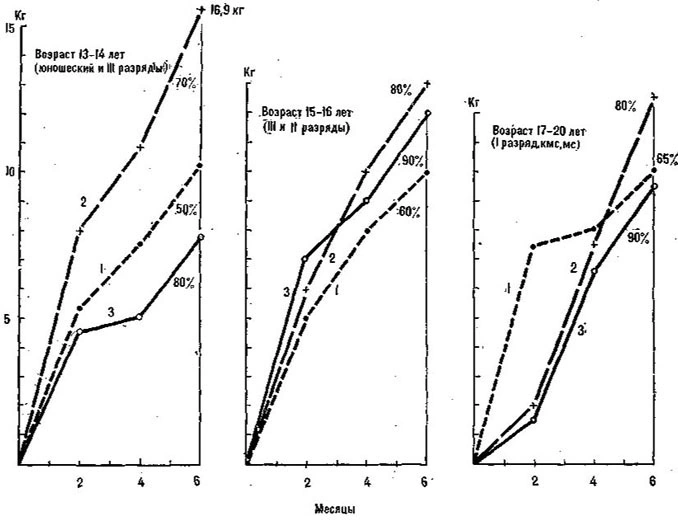
The back squat results (Fig. 2, Table 4) parallel this. After 2, 4 and 6 months the squat is done with some economisation of heart activity whatever the weight, and the effect of load size changes over the years. In subgroup I (50–65%), 13–14-year-olds at 50% again showed the greatest strain, 179 beats/min at six months; with age it fell markedly despite heavier weights, to 162 at 17–20, 9% lower. The training effect did not fall: six-month gains were steady at 10.3, 10 and 10 kg.
In subgroup II (70–80%), the best gains came at 70% for 13–14 and 80% for 15–16 and 17–20. The lower CVS response at 17–20 than at 15–16 did not reduce gains (13 and 12.5 kg), though the largest, 16.9 kg (30% more), was the 13–14s at 70%. In subgroup III (80–90%), CVS response was lowest, with little economisation; gains first accelerated, 7.8 kg at 13–14 (80%) and 12.2 kg at 15–16 (90%), then fell to 9.5 kg at 17–20 (90%). By squat gains the main load is 70% at 13–14 and 60–90% at 15–16 and 17–20, with a slight edge for 80%.
General conclusions
The snatch is technically complex and speed-strength, the back squat coordinatively simpler and strength-based. The authors think the snatch findings extend to the clean and jerk and to special-preparatory snatch and clean-and-jerk lead-ups, and the squat findings to front squats, good mornings, deadlifts and presses. They are:
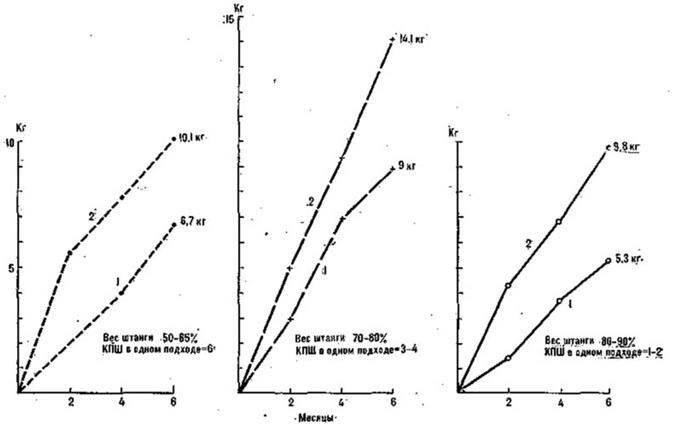
- The highest gains occurred in the lead-up strength exercise, the back squat (Fig. 3). Regardless of weight, six-month gains across all ages averaged 11.3 kg against 7 kg in the snatch, 38% less.
- The highest gains in both control exercises, 11.6 kg on average, came with 70–80% of maximum (3–4 BL per set, 18 per exercise). Loads of 50–65% (up to 6 BL per set) gave 8.4 kg, and 80–90% (1–2 BL per set, 12 per session) 7.8 kg. Over the years the main load is therefore 70–80% with 3–4 BL per set, in the best combination with heavy and light loads. Gains in complex lifts depend on how far motor potential is realised, so how well novices are taught technique, and how seriously qualified lifters keep improving it, decides how much speed-strength potential is used.
- Gains are mostly step-like and depend on exercise, weight, age (experience) and qualification (Figs. 1 and 2).
- Back squats at 50–65, 70–80 and 80–90% strain the CVS more (subgroup means of 172, 168 and 148 beats/min at the 10th second of recovery) than the snatch (160, 158 and 142; Table 4). Three reasons are suggested: the squat is continuous heavy work, overcoming and yielding; it comes at the end of a session, on top of fatigue; and trunk and leg muscles stay tense. This matters when judging true load at a session's end and in other exercises.
- Because multiple repetitions (3 to 6) at 50–80% load the CVS more than singles and doubles at 80–90%, the former is the more effective way to widen the CVS's functional capacity (Table 4).
- Snatches and squats at 70% (3–4 BL per set) and 80% (1–2 BL per set) come with greater economisation of the CVS (pulse down 13 beats/min on average over the half-year) than at 50–65% (6 BL per set) and 80% (3–4 BL per set), which gave 5; at 90% (1–2 BL per set) the drop was smaller still, 3.75.
To make optimal progress in sport-technical results, bar weight should be varied constantly, both within preparation cycles and in long-term planning, in line with these general and specific regularities for strength and complex exercises.