Technique
Lifting Technique of the World Record Holder O. Mirzoyan
English summary of Tyazhelaya Atletika. Ezhegodnik 1984 (Moscow: Fizkultura i Sport, 1984), pp. 19–29: the text is paraphrased, not translated; data tables are given in full with English labels; figures are the original images.
The article analyses Oksen Mirzoyan's (56 kg) snatches at the USSR Spartakiad of July 1983 (127.5 kg, a world record, missed and made, and a missed 130 kg) and his clean and jerks at the USSR Cup of December 1982 (158.5 kg, a world record, and a missed 160 kg) and at the Spartakiad (160 kg, a world record). Film sequences and Figs. 2 and 4 show the technique; cyclograms (Figs. 1 and 3) show the bar path.
Snatch
At the start Mirzoyan places his feet almost parallel, about hip-width apart, with the bar above the balls of the feet. The shins are inclined about 75° to the platform, the knee angles about 95° and the slightly rounded trunk about 17°. He then lowers the hips and arches the lower back: the shins tilt to about 64°, the trunk to 31°, the hip angles are about 36°, and the shoulders are about 8 cm ahead of the balls of the feet. The head is nearly vertical, the arms straight, the grip medium (frame 2).
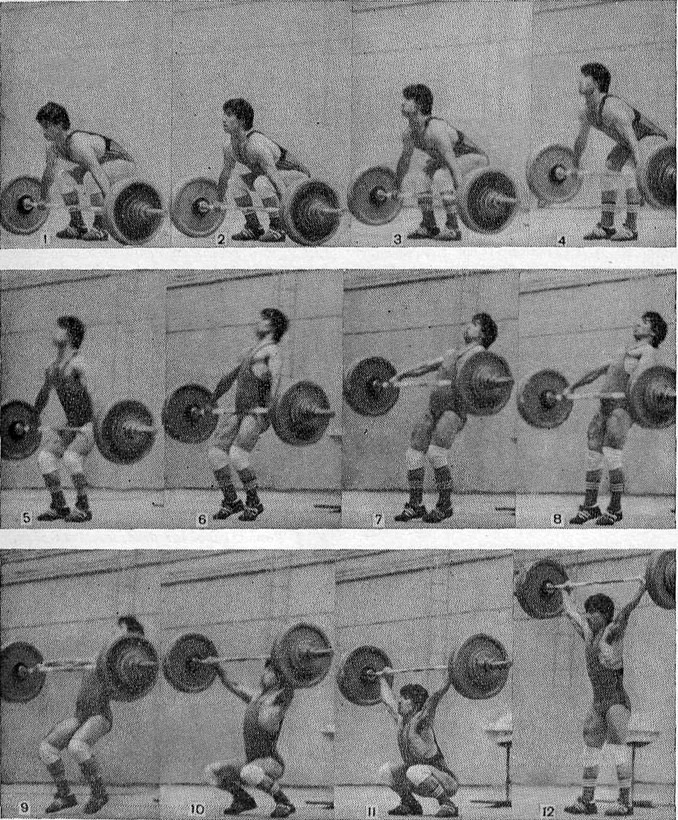
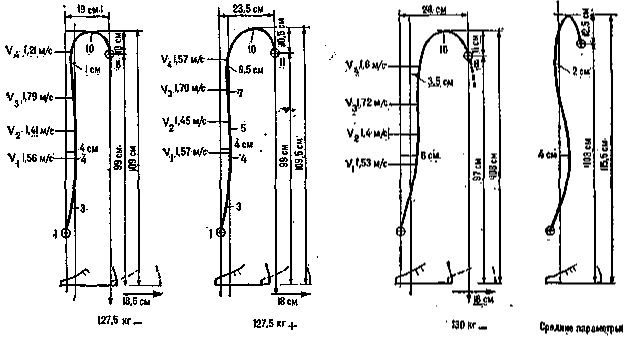
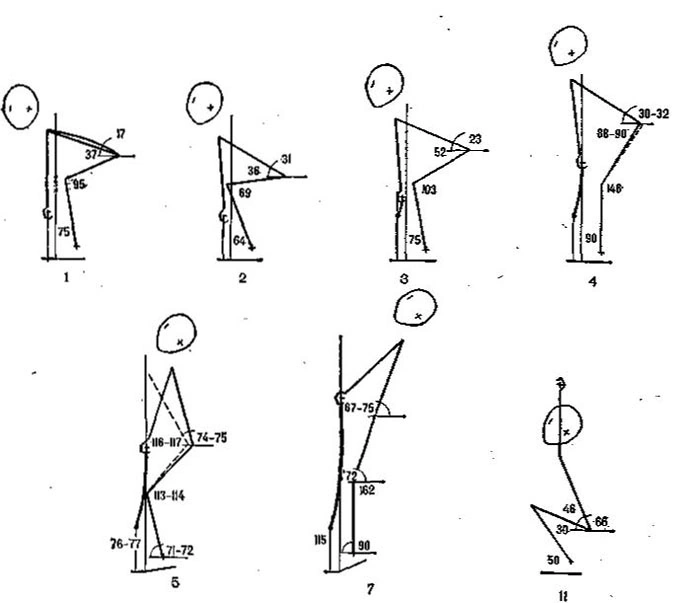
The bar is raised by active leg extension, with the trunk rising and at first leaning forward. When the bar is about 11 cm up the lean is greatest, about 23°, with knee angles of 103° and hip angles of 52° (frame 3). The legs keep extending until the knee angle is about 148° (145° on average for other lifters), the shins are vertical, the trunk is at 30–32° and the hips at 88–90° (85° for others; frame 4). The larger hip angles come from fuller knee extension than in others. The bar is now 54–55 cm high, above the knees and 4 cm closer than at the start.
He goes on lifting by extending the trunk at the hips. The backward-upward drive of the trunk sends the knees and hips forward and down, and the knees are brought under the bar until they reach 113–114° and the shins 71–72°. Mirzoyan makes this re-bend for longer than others (0.12 s), so his knees flex more (others average 120°), his trunk extends further (74–75° against about 60°) and his hip angle is 116–117° (others 110°). The phase ends with the whole foot on the platform, the bar over the balls of the feet and the shoulders about 14 cm behind it, whereas in other lifters they are over or in front of the bar (frame 5).
Bar speed after leg extension (pre-acceleration) is 1.53–1.57 m/s and falls to 1.4–1.45 m/s in the re-bend. From position 5 he makes the final pull, extending legs and trunk and rising on his toes with the heels 4 cm up (frames 6 and 7). This takes 0.08 s, the whole second phase 0.2 s. The body ends straight and leaning well back; the bar reaches 1.7–1.79 m/s, moving 0.5–1 cm in front of the balls of the feet, then up and back towards the lifter more than is optimal.
In the squat (frames 8–11) he pushes on the bar with his arms and brings the trunk under it. He stays in contact with the platform for 0.04–0.08 s after the pull, and the airborne part lasts 0.12–0.16 s, during which the bar keeps rising thanks partly to the arms. In the air he spreads the feet sideways and 18–18.5 cm back and lands as the bar reaches its top (frame 10). In the fixed squat the trunk leans about 66°, the knees are at about 30°, the shins at about 50° and the bar is over mid-foot (frame 11).
The amortisation part of the squat lasts 0.21–0.25 s and the bar path ends in a downward loop 23.5 cm from the start in the successful attempt. Mirzoyan lifts 127.5 kg to 109–109.5 cm and 130 kg to 108 cm; the bar sinks 10–10.5 cm and is fixed at 99 cm (his height is 156 cm). He then stands with the bar locked out (frame 12).
Table 1. Spatial and temporal characteristics of O. Mirzoyan's snatch
| Parameter | Weight lifted, kg | ||
| 127.5 (–) | 127.5 (+) | 130 (–) | |
| Movement of the bar towards the lifter in the first phase relative to its starting position, cm | 4 | 4 | 6 |
| Movement of the bar in the pull relative to the balls of the feet, cm | 0.5 | 1 | –3.5 |
| Bar speed after pre-acceleration, m/s (V1) | 1.56 | 1.57 | 1.53 |
| Distance covered on reaching V1, cm | 55 | 57 | 51 |
| Bar speed during the knee re-bend under the bar, m/s | 1.41 | 1.45 | 1.4 |
| Distance covered on reaching V2, cm | 67 | 69.5 | 63.5 |
| Maximum speed in the pull, m/s (V3) | 1.79 | 1.7 | 1.72 |
| Distance covered on reaching V3, cm | 80.5 | 83 | 76.5 |
| Possible flight height of the bar owing to V3, cm | 97 | 98 | 91.5 |
| Actual height to which the bar was lifted, cm | 109 | 109.5 | 108 |
| Bar speed after the leg push-off, m/s (V4) | 1.21 | 1.57 | 1.6 |
| Distance covered on reaching V4, cm | 100 | 96.5 | 93 |
| Possible flight height of the bar owing to V4, cm | 7.3 | 12.5 | 13 |
| Distance actually travelled by the bar to its maximum height, cm | 9 | 13 | 15 |
| Bar movement owing to interaction in the airborne phase, cm | 1.7 | 0.5 | 2.0 |
| Height of fixation in the squat, cm | 99 | 99 | 97 |
| Total time of the second phase (pull), s | 0.2 | 0.2 | 0.2 |
| Of which: duration of the knee re-bend | 0.12 | 0.12 | 0.12 |
| Duration of the final acceleration | 0.08 | 0.08 | 0.08 |
| Time on the platform before the feet are spread, s | 0.08 | 0.04 | 0.06 |
| Time of the airborne part of the squat, s | 0.12 | 0.12 | 0.16 |
| Time of the amortisation part of the squat, s | 0.25 | 0.21 | 0.21 |
Notes. 1. In the header a minus in brackets means the bar was not fixed, a plus that it was lifted. 2. In the second row a minus means the bar moved towards the lifter relative to the balls of the feet; otherwise it moves away. 3. Bar speed was determined at 24 frames per second.
For a lifter of Mirzoyan's height the minimum lift height that still allows fixation is 109 cm, with a fixation point of 97.5 cm. He fixed record weights at the minimum possible height, which shows the high skill of his squat. Why, then, did the first 127.5 kg attempt and the 130 kg attempt fail?
The first pull and re-bend were much the same in all three attempts; the final acceleration differed. In the first attempt the trunk leaned back much less in the pull (75° against 67° and 65°), so the bar came towards him by only 19 cm (23.5 and 29 cm in the others). He set his feet back 18.5 cm, as in the later attempts (18 cm), so the bar stayed in front, its projection at the toe line (position 11, Fig. 1); the common centre of gravity fell outside the zone of stable equilibrium and the bar dropped forward.
With 130 kg the bar rose to 108 cm, below the minimum for fixation, and with an amortisation of 11 cm it was caught at 97 cm, 2 cm below his optimal 99 cm. To hold it he had to lower the hips and so relaxed the lower back. The trunk leaned back most (65°), the bar came 29 cm towards him and the centre of gravity projected nearer the ankles; with the back relaxed he could not hold it and it fell backward.
Inertia after the pull alone would have carried the bar to 97, 98 and 91.5 cm, yet it went to 109, 109.5 and 108 cm. Mirzoyan does not squat immediately after full extension: for a moment he still pushes on the platform while acting on the bar with bent arms and slightly lowering the trunk. During this contact (0.08, 0.04 and 0.06 s) the bar travelled 14, 7 and 10.5 cm. Without it, bar speed at the end of contact would have been 0.70, 1.25 and 0.94 m/s; in fact it was 1.54, 1.50 and 1.55 m/s. After the push-off it was 1.21 m/s (failed 127.5 kg), 1.57 (record 127.5 kg) and 1.6 m/s (130 kg), at heights of 100, 96.5 and 93 cm, which would allow only 107.3, 109 and 106 cm. The rest comes from the acceleration he gives the bar in the airborne phase.
Clean and Jerk
The clean
At the start Mirzoyan sets his feet slightly wider than the hips, nearly parallel, with the bar over the balls of the feet. The shins are inclined about 80°, the knee angles about 115° and the slightly rounded trunk almost 15°. He then lowers the hips and arches the lower back: the shins tilt to about 62°, the knees to about 80°, the trunk to 32°, the hip angles to about 50°, and the shoulders are almost 10 cm ahead of the bar line (frame 2, position 2 in Figs. 3 and 4).
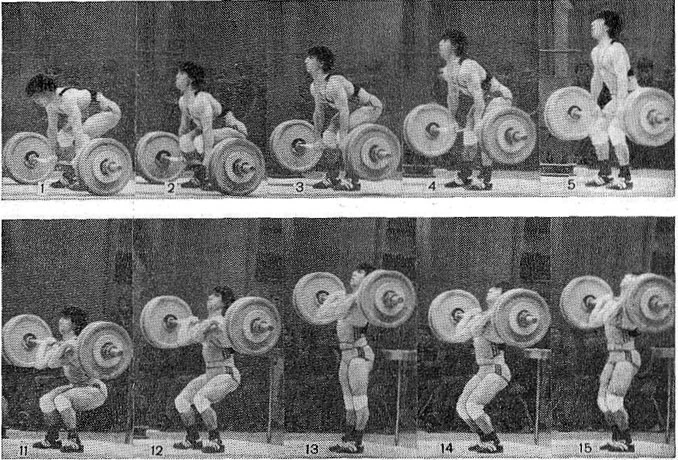
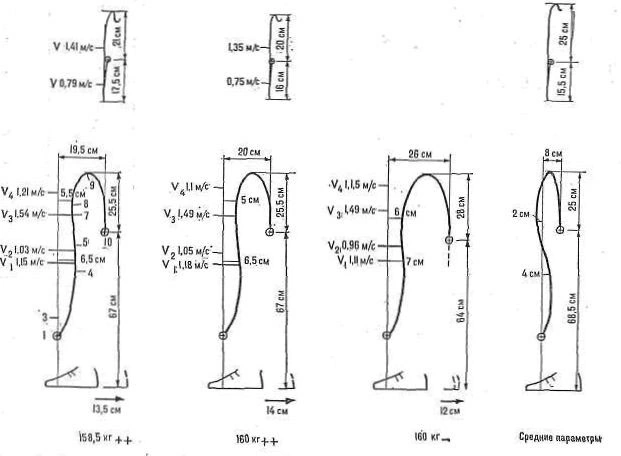
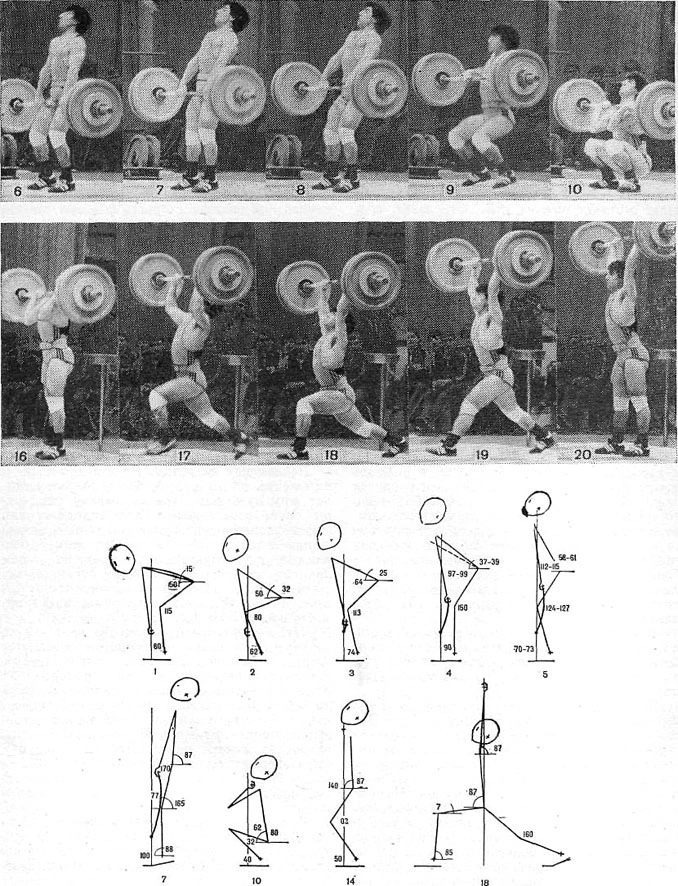
The bar rises by active knee extension. With the bar about 8 cm up the knees are at about 113°, the hips at 64°, the trunk at its greatest lean of about 25°, the shoulders at most 12 cm forward, and the bar 3–4 cm towards him (frame 3). He stops extending the legs at 150° (as others do on average), with the shins vertical, the trunk at 37–39° and the hips at 97–99°; the shoulders are 4 cm ahead of the balls of the feet and 10 cm ahead of the bar, which is just above the knees at 48–49 cm (frame 4). At 53–55 cm the bar reaches the first-pull maximum, 1.11–1.18 m/s.
The pull follows. The knee re-bend lasts 0.06–0.08 s and the knees flex to 124–127°, leaving the bar near mid-thigh with its projection at mid-foot, the shoulders about 2.5 cm ahead of it, the trunk at 58–61° and the shins at 70–73° (frame 5). The final acceleration takes 0.09–0.12 s, with legs and trunk extending, the toes taking the weight and the bar reaching 1.49–1.54 m/s. The bar first moves slightly towards him, then 1 cm forward and up, ending 5–6 cm behind its start (frames 6 and 7); the knees are then at about 165°, the hips at about 170° and the heels 4 cm up.
In the squat (frames 8–10) he still rests on his toes for 0.06–0.1 s after the final effort, and the airborne part lasts 0.07–0.09 s. The squat uses not only body weight but a pronounced active interaction with the bar: the arms, first flexors and then extensors, push against it and bring the trunk under. Bar speed rose from 0.86–1.01 m/s before the push-off to 1.1–1.21 m/s after it, and in the 158.5 kg clean the bar gained a further 1 cm in the airborne phase (Table 2). The bar path curves backward and ends in a downward loop as he spreads the feet sideways and slightly back. When the feet land the bar is at its maximum, 92–92.5 cm; during the 0.37–0.42 s amortisation it sinks 25.5 cm in successful lifts and is fixed on the chest at 67 cm. These heights are average for the national team.
In the failed 160 kg attempt the bar was fixed at 64 cm rather than his optimal height, which was possible only because he lowered the hips 6 cm more and relaxed the lower back. The bar came 26 cm towards him (19.5–20 cm in the other attempts) and he jumped back only 12 cm, so the projection of the common centre of gravity lay on the edge of the base (Fig. 3); lowering the hips unbalanced him and he could not stay in the squat.
Table 2. Spatial and temporal characteristics of O. Mirzoyan's clean and jerk
| Parameter | Weight lifted, kg | ||
| 158.5 (+) | 160 (+) | 160 (–) | |
| Movement of the bar towards the lifter in the first phase relative to its starting position, cm | 6.5 | 6.5 | 7 |
| Movement of the bar in the pull relative to the balls of the feet, cm | –5.5 | –5 | –6 |
| Bar speed after pre-acceleration, m/s (V1) | 1.15 | 1.18 | 1.11 |
| Distance covered on reaching V1, cm | 54.5 | 53 | 55 |
| Bar speed during the knee re-bend under the bar, m/s (V2) | 1.03 | 1.05 | 0.96 |
| Distance covered on reaching V2, cm | 59 | 58 | 61 |
| Maximum speed in the pull, m/s (V3) | 1.54 | 1.49 | 1.49 |
| Distance covered on reaching V3, cm | 74.5 | 74 | 76.5 |
| Possible flight height of the bar owing to V3, cm | 86.5 | 85.5 | 88 |
| Actual height to which the bar was lifted, cm | 92.5 | 92.5 | 92 |
| Bar speed before the leg push-off, m/s | 1.01 | 0.86 | 0.9 |
| Bar speed after the leg push-off from the platform, m/s (V4) | 1.21 | 1.10 | 1.15 |
| Distance covered on reaching V4, cm | 84 | 86.5 | 85.5 |
| Possible flight height of the bar owing to V4, cm | 7.5 | 6.1 | 6.7 |
| Distance actually travelled by the bar to its maximum height, cm | 8.5 | 6 | 6.7 |
| Movement of the bar towards the lifter relative to its starting position, cm | 19.5 | 20 | 26 |
| Size of the amortisation part of the squat, cm | 25.5 | 25.5 | 28 |
| Height of fixation of the bar in the squat, cm | 67 | 67 | 64 |
| Total time of the second phase (pull), s | 0.17 | 0.18 | 0.20 |
| Of which: time of the knee re-bend | 0.08 | 0.06 | 0.08 |
| Time of the final acceleration | 0.09 | 0.12 | 0.12 |
| Time on the platform before the feet are spread, s | 0.06 | 0.1 | 0.05 |
| Time of the airborne part of the squat, s | 0.09 | 0.07 | 0.07 |
| Time of the amortisation part of the squat, s | 0.42 | 0.37 | 0.42 |
See the notes to Table 1.
With the bar on the chest the trunk leans slightly forward, the knees are apart and the elbows raised (frame 10, position 10). He then raises the hips, leans a little more and stands up for the jerk (frames 11–13). Acceleration was practically the same in all three attempts, though slightly faster at its end in the successful ones. In the pull the bar covered practically the same distance (26.5 cm at 158.5 kg and in the failed 160 kg, 26 cm in the record 160 kg), but the final effort took 0.09 s at 158.5 kg and 0.12 s at 160 kg, giving speeds of 1.54 and 1.49 m/s.
The jerk
For the jerk Mirzoyan puts the hips slightly back, with the common centre of gravity of lifter and bar at mid-foot. In the half-squat he does not shift the hips back as the knees move forward, so the centre moves 1.5 cm forward (frames 13 and 14). The half-squat is 16–17.5 cm deep, 10.3–11.2% of his height, with knees at 100–103°, and takes 0.5 s. Its speed rises to 0.75–0.79 m/s, then he brakes and stops the bar: about 0.35 s before braking (10–11 cm of bar travel), 0.15 s of braking (6–6.5 cm) and a 0.04 s pause. Rising back to the start (frame 15) takes 0.22 s.
The bar reaches its maximum departure speed, 1.35–1.41 m/s, 9 cm above the start. He straightens the knees and prepares to squat (frame 16) as the bar leaves the chest, then pushes on it with his arms and sends the trunk down (frames 17 and 18). The bar moves in a straight line, drifting up and back only as he spreads the feet, and is pushed 20–21 cm up in about 0.46 s. The front foot lands slightly more than a foot-length from the projection of the hip joints and the rear foot almost two; the front shin leans towards him (85°) and the rear knee is at about 160° (frame 18). This gives stable balance with the hips low. He then brings the feet together and fixes the bar overhead (frames 19 and 20).